Season 1 · Episode 1
Behold the sun and all of it's glory. Learn all things about the sun ranging from its beginning to its death. Also learn about how stars work in general and MUCH MUCH more.

Visit the planet most like Earth. There is a discussion of what life on Mars would be like and about the life forms that could've evolved there.
Asteroids, comets, gamma ray bursts and the sun all combine to make the Earth a dangerous place to live. NASA's top brass and other scientists are arming themselves with the latest technology to pre-empt an apocalyptic attack. Watch and investigate bizarre, and terrifying apocalyptic scenarios and the ways that scientists are racing against the clock to develop technology to defend our planet.
Jupiter poses many questions about our solar system. It is a powerful planet of gas whose flowing colors and spots are beautiful, but contain violent storms and jet streams. A mini solar system of over sixty moons rotate around Jupiter--a half billion miles from earth. Could one of these moons contain life under its icy crust?
The moon has comforted man for thousands of years. It's been everything from a god to a compass, and the only cosmic body human beings have ever visited. NASA is planning to build a permanent outpost there. Discover how the moon came to be--if you don't already know, you will be astounded.
Take a high performance ride through the formation of the third planet from the Sun, Earth... A survivor of one of the most violent "neighborhoods" in the Universe, learn how Earth was created and discover what creatures hold clues to how life began. What evil forces threaten the demise of Earth? Complex and controversial, this is the scientific detective story of all time.
Examining Mercury and Venus. Included: exploring how the damages they've suffered from cosmic collisions and acid rain may serve as a warning for Earth.
Are the rings of Saturn a real celestial phenomenon or merely a cosmic Illusion? Technology allows the experts to get closer to the furthest planet visible to the naked eye. Old questions are answered and new ones arise. Does Saturn hold the key to Earth's weather and will one of its moons supply us with all the oil we'll ever need?
Our galaxy is one of hundreds of billions in the universe. View of universe through the Hubble telescope and go back almost all the way to the Big Bang.
Ignited by the power of the atom, burning with light, heat and wrath, stars are anything but peaceful. They collide, devour each other, and explode in enormous supernovas--the biggest explosions in the Universe.
This episode details outer lying planets and their moons. Included will be Uranus, Neptune, and Pluto. Using CGI, we will also see what alien life might look like on other worlds.
Take a tour of the cosmic hot zones--black holes, galaxy mergers, gamma ray bursts and magnetars. Super black holes can literally lasso Earth out of the solar system. A clash between two galaxies can result in a ritual called galactic cannibalism. Magnetars are a cosmic magnetic force so strong it could wipe out data on every credit card.
Are we alone? SETI--the Search for Extraterrestrial Intelligence--is a privately funded project using radio telescopes and optical telescopes to scan the stars for signals.
The universe began with a massive expansion, billions and billions of years ago, and it continues to expand with every passing second. The idea that the universe, and man's very existence, began with a "Big Bang" is no longer a topic of debate among most scientists--it is essentially taken as fact.
With the help of industry experts, this innovative docuseries examines new and emerging technological trends to imagine revolutionary possibilities.
2022
Jean-Michel Vanasse and Marilou Ethier set out to explore the world of new technologies that are transforming our relationship to sex.
2021
Take a mind-blowing journey through human history, told through six iconic objects that modern people take for granted, and see how science, invention and technology built on one another to change everything.
2019
Famed astrophysicist Neil deGrasse Tyson provides clarity for the vision of the cosmos as he voyages across the universe with never-before-told stories that delve into the scientific concepts of the laws of gravity and the origins of space and time.
2014
Carl Sagan covers a wide range of scientific subjects, including the origin of life and a perspective of our place in the universe.
1980
In each episode, geologist Dr. Iain Stewart explains the effects and importance of a specific force of nature, such as wind or volcanism. He also examines the various ways in which it shapes planet earth itself and influences life on it, often in conjunction with other natural forces, and sometimes with lifeforms, as in the 'apocalyptically' grave case of global warming.
2007
No description available.
2009
An unprecedented look at the decade-long odyssey to land a man on the moon. This documentary pulls back the curtain on the familiar narrative of the moonshot, revealing a fascinating stew of scientific innovation, political calculation, media spectacle, visionary impulses and personal drama.
Dive into the field of natural science, Discover the Solar System or the various functions of the human body. The information is presented in the "Eyewitness Museum", a computer-generated science museum. Various exhibits are shown, and stock video footage is usually seen through large windows or other depressions in the wall.
1995
This BBC series offers a fresh look at an amazing organization and mankind's quest to understand the universe. Blending stunningly restored footage with revealing, insightful and engaging interviews with the people who were there - the astronauts, family members and journalists - this is an epic story of the heroes, the triumphs and the tragedies of space exploration. Starting with NASA's beginnings in the Cold War, the series follows the iconic moments of space exploration from the race to get the first man in space to the first steps on the moon. And with triumph and achievement comes risk and disaster, as the series follows the white-knuckle suspense of Apollo 13 and the tragedy of the shuttle Challenger. Intelligent, inspiring and accessible, The Space Age is a complete history of mankind's journey into space.
2011
Professor Brian Cox explores the dramatic lives of the eight majestic planets/worlds that make up our solar system.
2016
July 20, 1969. Nearly six hundred million people have their eyes glued to their televisions: Neil Armstrong is just about to make one of mankind’s oldest dreams come true. After more than twenty years of intense struggle between the Americans and the Soviets, the biggest adventure for humanity in the 20th century has just been achieved. As a climax of the Cold War, the conquest of the moon was a true saga, passionate, epic and filled with twists and turns. It wasn’t just a scientific competition between East and West; It was also a fabulous adventure combining political history, technological exploits, acts of bravery and personal dramas.
All In Earth's 4 billion year history, nature has solved all of lifes problems, from the highest mountain to the deepest ocean. Evolution is the ultimate inventor and many of mans most clever engineering solutions have exact counterparts in nature. In three amazing episodes, NatureTech views our world with fresh eyes, where nature and technology stand hand in hand.
2006
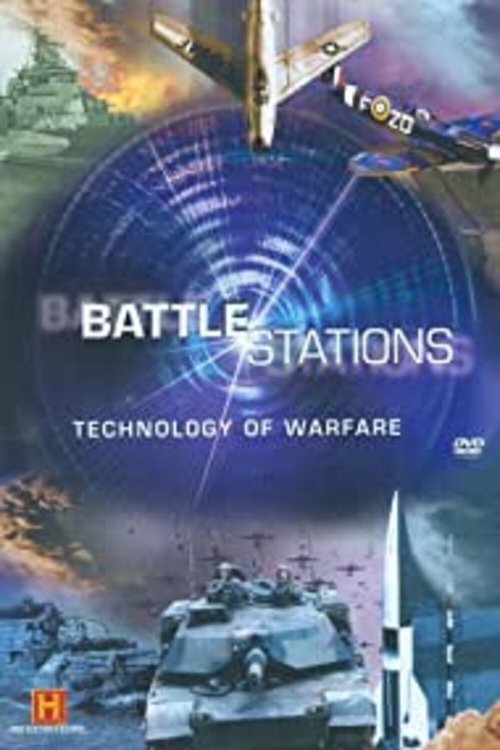
Battle Stations is a documentary series of 1 hour episodes, which uses archive footage, re-enactments and first-hand accounts from the crews, to follow the machines and technology implemented from the Second World War to the Gulf War in the land, air and sea.
2000
1998