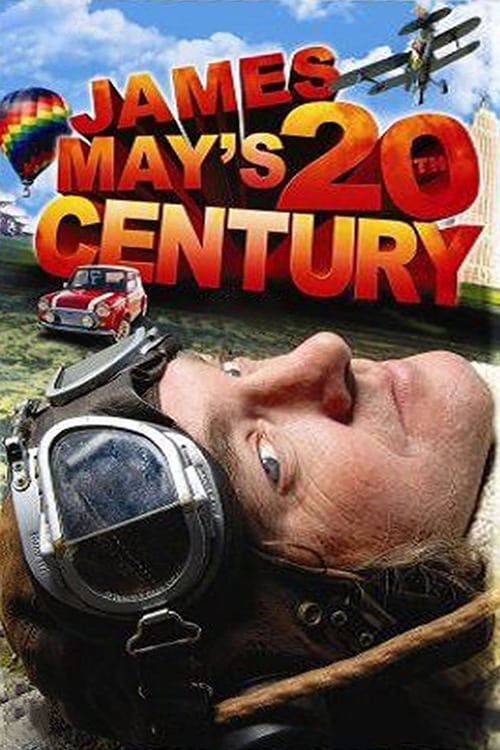
James May's 20th Century★ 7.620071 season~30mEndedDocumentaryJames May takes a look at some of the greatest developments of the 20th century.Watch NowNetworkBBC TwoLanguageEnglishEpisodesSeason 1E1Honey, I Shrunk The WorldAt the beginning of the 20th Century, long distance travel was for the military-minded, the uprooted and the plain rich, but the pioneers of flight were to change all that. To find out how, James May gets his hands on a Vickers Vimy aircraft that in 1919 carried two intrepid Brits, Alcock and Brown, across the Atlantic for the first time. But it wasn’t just flying that changed our perception of the world. The motor car offered us a new sense of freedom, but when James tries out a 1908 Model T Ford, he discovers driving was once a very tricky business indeed. As he observes: "The right pedal was the brake and the middle pedal was reverse gear. There was no clutch as such: the left pedal was both clutch and forward gears - depending on how far pressed. I’m amazed this driving thing ever took off. " Shrinking the world wasn’t just about travel becoming easier and more affordable. For the first time in history we could bring the world to us via the cinema. James shoots his own black and white newsreel at Walthamstow Dog Track and looks back at the early days of television when two different formats fought for supremacy. Finally, James faces a dilemma: in 1969, two technologies emerged that promised to change our world forever. The first was the supersonic aircraft, Concorde. The second was computer messages, one day millions of emails would travel the world thanks to optic fibre cables. But in the late sixties which one would he have backed? "Don’t you think it’s weird that when it comes to shrinking the world, this piece of fibre has completely triumphed over that magnificent supersonic airliner? It seems to me we spent the first three-quarters of the 20th century going out into the world, trying to see more and more of it, and then in the last few decades we’ve realised that actually we can bring quite a lot of it to us down this optical string thing."2007-07-10· 30mE2Blast OffLike many small boys James May dreamt of becoming an astronaut. Even though he may not have realised his dream he sets off to find out what space exploration has done for him, and the rest of us. And he’s got just the right motor to begin the journey - a moon buggy… "The moon buggy, or ‘Lunar Rover Vehicle’ to give it its proper name, has to have been the most expensive car ever made. It cost 38 million dollars. And that didn’t include delivery". His first stop is Staveley Road, Chiswick, West London. It was here that Britain felt the first impact of the space race in 1944, when the street was struck by a Nazi V2 – the rocket powered terror weapon, and the distant ancestor of the Saturn V that put a man on the Moon in 1969. Next James links up with a team of amateur rocketeers to understand the pyrotechnic principles of rocket science first hand, before heading to Cape Canaveral in Florida, to see the real deal for himself. Here he meets a veteran of the Apollo programme and pays homage to the massive, 525ft, Saturn V. From there he probes the depths of the universe thanks to the enormous radio telescope at Jodrell Bank, and confronts the full implications of the revolutionary 20th Century theory - the Big Bang. Then it’s off to Mission Control, Guildford, where James borrows a satellite orbiting 700km overhead to take a photograph of Earth. Finally James talks to astronaut John Blaha, who has spent nearly six months in orbit, in order to understand how going into space changes the way you see the world. "Even the pilot of Apollo 9 said he felt lucky to be "looking down like a guardian angel on all of history and music.. of life and love". And it’s not like he was a hippy or anything", says James.2007-07-10· 30mE3Body FantasticJames sets out to discover how far he can push his body and finds out about some of the most remarkable medical advances over the last hundred years. He begins by testing himself in a centrifuge – a machine that can make fighter pilots and astronauts break out in a cold sweat. He wants to find out what would happen to his body when it is subjected to high forces. As he reached 4.4 g – he passed out: "There was no doubt that I’d clearly reached my limit. The blood was forced from my head to my feet and I passed out." He then tries out anti-g trousers, and manages to get to 5.4 g without passing out. Next stop is New York where James meets a group of athletes that have pushed their bodies to the limit to get extraordinary results. These elite sportsmen and women have each lost a leg – but are able to run long distances at high speed thanks to hi-tech prosthetic replacements. They are now winning against able-bodied competitors, a success which has brought the remarkable complaint that the disabled athletes may have a competitive advantage because of their artificial limbs. Back in the UK James is invited to watch open heart surgery - and sees a man’s heart come to a complete stop during the operation. But James’ biggest surprise came when he looked at one of the 20th century’s greatest medical breakthroughs – the discovery of DNA. He had his DNA tested: "To be honest I’m so English that I’m assuming I’m descended from a piece of fruit cake and cricket bat, but let’s see." The results, however, were not at all what he expected.2007-07-17· 30mE4Take CoverIn Take Cover, James looks at how warfare drives ingenuity and gets to fly in the RAF’s latest supersonic jet. It’s an experience that he describes as "the most amazing thing I have ever done". The film begins by looking at the early days of air war at the start of the 20th Century. James flies in a biplane to get to grips with how difficult it was for the early aviators to hit any targets. Using flour bombs, he tries to hit a target on the ground. It’s a lot more difficult than he imagined. He also meets a group of ex-Paras to try some "make up for men", camouflage paint. When he fails to spot the Paras hidden in the woods he turns to modern technology for help. James moves on to look at "the biggest art show of the century", one of the most curious innovations to come from the military world. It’s called dazzle camouflage, and it involved painting warships in a confusing series of lines and stripes. Thousands of ships were painted like this to confuse German U boats during the First World War. Finally James meets up with Squadron Leader Paul Godfrey. He’s been invited to fly in the Typhoon, the RAF’s latest jet fighter. He has a private pilot’s licence - but only at 4,000ft at 120 knots. The Typhoon is a plane that can go from a standing start to six miles high in 150 seconds. After landing James admits he was slightly emotional: "Well, I admit I was a bit nervous when we set off but, absolutely unquestionably and not anything to do with bigging it up for television, that was the best thing I have ever experienced. It is, it is breathtaking, it really is, I can’t really describe what it’s like. It’s life-changing, frankly."2007-07-17· 30mE5Inventing The TeenagerIn the 20th Century the teenager emerged as a separate species. But how? Was it the promise of sex? The power of pop? Or the pull of a 50cc Japanese two-stroke? James May is on a journey to find out. First up is fashion. The 20th century introduced fantastic new fabrics in fantastic new colours thanks to synthetic materials like Nylon. James tries his hand at making some for himself with some success. Close to James’s heart, of course was teenage transport, offering liberation from parents and the home. When he was a teenager he always dreamed of owning a very special motorbike, the Yamaha FS1E. The Fizzy. "The problem was of course, was that my mother would rather I played with something like a used hypodermic needle. The FS1E – a motorcycle you could ride at 16 - was just a symbol of death. It was like your son’s tombstone placed before you. It was ‘Not Allowed’." Finally he checks out the origins of the electric guitar – that potent symbol of teenage rock music. Who better to explain its power than the oldest teenagers in town Francis Rossi and Rick Parfitt of Status Quo. As Rick explains: "It’s just the magic of plugging into an amplifier. You put on a vibrato and you could sound good even if you weren’t. Volume is like speed – you buy a fast car because you want to be faster, you buy a big amp because you want to be louder…."2007-07-24· 30mE6Big City, Bright LightsEach day, 180,000 people move into a city somewhere on the planet. In Big City, Bright Lights, James sets out to discover how we’ve created this high-rise, 24/7 experiment in urban living. He heads for New York – to the top floors of the Woolworth building, once the tallest building in the world. It’s being renovated, but how strong is it? To find out he decides to drop a 1982 Mini 1000 onto a plate of skyscraper glass. At the start of the 20th Century there was no national grid, no agreed system of voltage and James discovers that in 1922 there were 22 different plugs used across the country. Until a Geordie electricial engineer, Charles Merz, came up with a master plan: "The Merz mantra was unprecedented. One nation. One voltage. One plug." But there’s one light bulb James wants to find out about – one that was invented in the 20th century: "There’s one form of light that radiates come-hither hues to all those who are looking for some action… This light tempts you to the dark side! You won’t see a neon sign on a Methodist church or a lending library. Some unwritten convention says neon is used to advertise illicit pleasures that happen late into the night…" He meets master neon-bender Steve, as he attempts to make a neon sign for his favourite restaurant, his local kebab shop.2007-07-24· 30mTop CastJames MayHimself - Presenter📺More Like This‹›TVJean-Michel Vanasse and Marilou Ethier set out to explore the world of new technologies that are transforming our relationship to sex.Sexe + Techno2021★7.8TVTake a mind-blowing journey through human history, told through six iconic objects that modern people take for granted, and see how science, invention and technology built on one another to change everything.Breakthrough: The Ideas That Changed the World2019★10.0TVAll In Earth's 4 billion year history, nature has solved all of lifes problems, from the highest mountain to the deepest ocean. Evolution is the ultimate inventor and many of mans most clever engineering solutions have exact counterparts in nature. In three amazing episodes, NatureTech views our world with fresh eyes, where nature and technology stand hand in hand.Nature Tech2006★8.0TVFrom the planets to the stars and out to the edge of the unknown, history and science collide in a wondrous yet deadly adventure through space and time.The Universe2007★2.0TVBattle Stations is a documentary series of 1 hour episodes, which uses archive footage, re-enactments and first-hand accounts from the crews, to follow the machines and technology implemented from the Second World War to the Gulf War in the land, air and sea.Battle Stations2000★6.6TVIn the series, "Wallace will take a light hearted and humorous look at the real-life inventors, contraptions, gadgets and inventions, with the silent help of Gromit. The series aims to inspire a whole new generation of innovative minds by showing them real, but mind-boggling, machines and inventions from around the world that have influenced his illustrious inventing career" (the BBC press statement). Peter Sallis reprised his role as the voice of Wallace. The filmed inserts are mostly narrated by Ashley Jensen, with one in each episode presented in-vision by Jem Stansfield. John Sparkes also voices a portion in the unseen character of archivist Goronwy.Wallace & Gromit's World of Invention2010★8.1TVExplore the impact of A.I. and how it is transforming the way we live and work -- both now and in the future, featuring some of the brightest minds in science, philosophy, technology, engineering, medicine, futurism, entertainment and the arts to tell the dynamic story of A.I.The Age of A.I.2019★7.7TVAncient Impossible, the new H2 series, picks up where HISTORY’s long running Ancient Discoveries left off. In this next generation of storytelling, Ancient Impossible reveals how many of today’s technological achievements were actually developed centuries ago. Colossal monuments, impossible feats of engineering and technologies so precise they defy reinvention–the ancient world was far more advanced than we ever imagined. We’ll travel through history to reveal a radically different picture of the past, with innovations so far ahead of their time, they’re still in use today. New science uncovers a lost world more like our own than we ever suspected, and reveals how modern technology has its blueprint in the ancient world.Ancient Impossible2015★9.0TVFollow tech guru Marques Brownlee as he uncovers how iconic technology of the past came to life and shaped history. In each episode, Marques meets with fellow YouTube creators, experts, and celebrity guests, to explore the impact each piece of vintage tech has had on our culture and why these pieces remain so revolutionary.Retro Tech2019TVA high-end documentary series that takes a deep and thought-provoking dive into a variety of topics - such as the future of human life extension, breakthroughs in interspecies communication, the rise of “cyborgism”, existing in virtual reality, and more.Life 2.02020TVScientists, researchers, and entrepreneurs are revolutionizing the way people see, touch, taste, hear, and smell with cutting-edge advances in technology.Human + The Future of Our Senses2019★7.4TVIt's "Mr. Wizard" for a different decade. Bill Nye is the Science Guy, a host who's hooked on experimenting and explaining. Picking one topic per show (like the human heart or electricity), Nye gets creative with teaching kids and adults alike the nuances of science.Bill Nye the Science Guy1993★5.9TVProviding a thought-provoking and imaginative perspective on scientific discovery as it unfolds, each episode follows scientific explorers working on cutting-edge projects with breakthrough potential, revealing the world of tomorrow... today.Breakthrough2015★6.5TVEvery time we switch on a light or boil a kettle we rely on power - but most people don't stop to think about the inventions and discoveries that allow us to live the way we do. In an exciting new four-part series for BBC Two, The Genius of Invention reveals the fascinating chain of events behind inventions that make everyday life possible.The Genius of Invention2013★10.0TVIn 2022, many countries will step into the metaverse world, and "Open Mind" will introduce the audience to the high-tech business opportunities that are expected in the market! Each episode discusses the cognition of emerging investment tools, what are the development potentials and investment opportunities? In recent years, the hot virtual currency and the NFT that has set off a wave of the whole city, are they worth investing in? The new era in the Metaverse is worth blogging business opportunities, and the program deconstructs you one by one!Open Mind2022★7.7TVNaked Science is an American documentary television series that premiered in 2004 on the National Geographic Channel. The program features various subjects related to science and technology. Some of the views expressed might be considered fringe or pseudo-science, and some of the scientists may present opinions which have not been properly peer-reviewed or are not widely accepted within their scientific communities, in particular on topics such as Bermuda Triangle or Atlantis for example.Superscience2004← Back to TV shows